Showing posts with label Tbilisi. Show all posts

Wednesday, August 4, 2010

The statue of Sergei Parajanov


WE searched for nearly an hour to find the statue of Sergei Parajanov, avant garde filmmaker and artist. Sierra spotted it, perched on the side of a wall in a small alley. It was totally unmarked, and when we asked the waitress at the cafe next to it, she had no idea who Parajanov was.

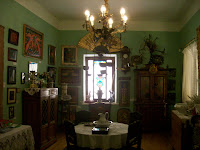
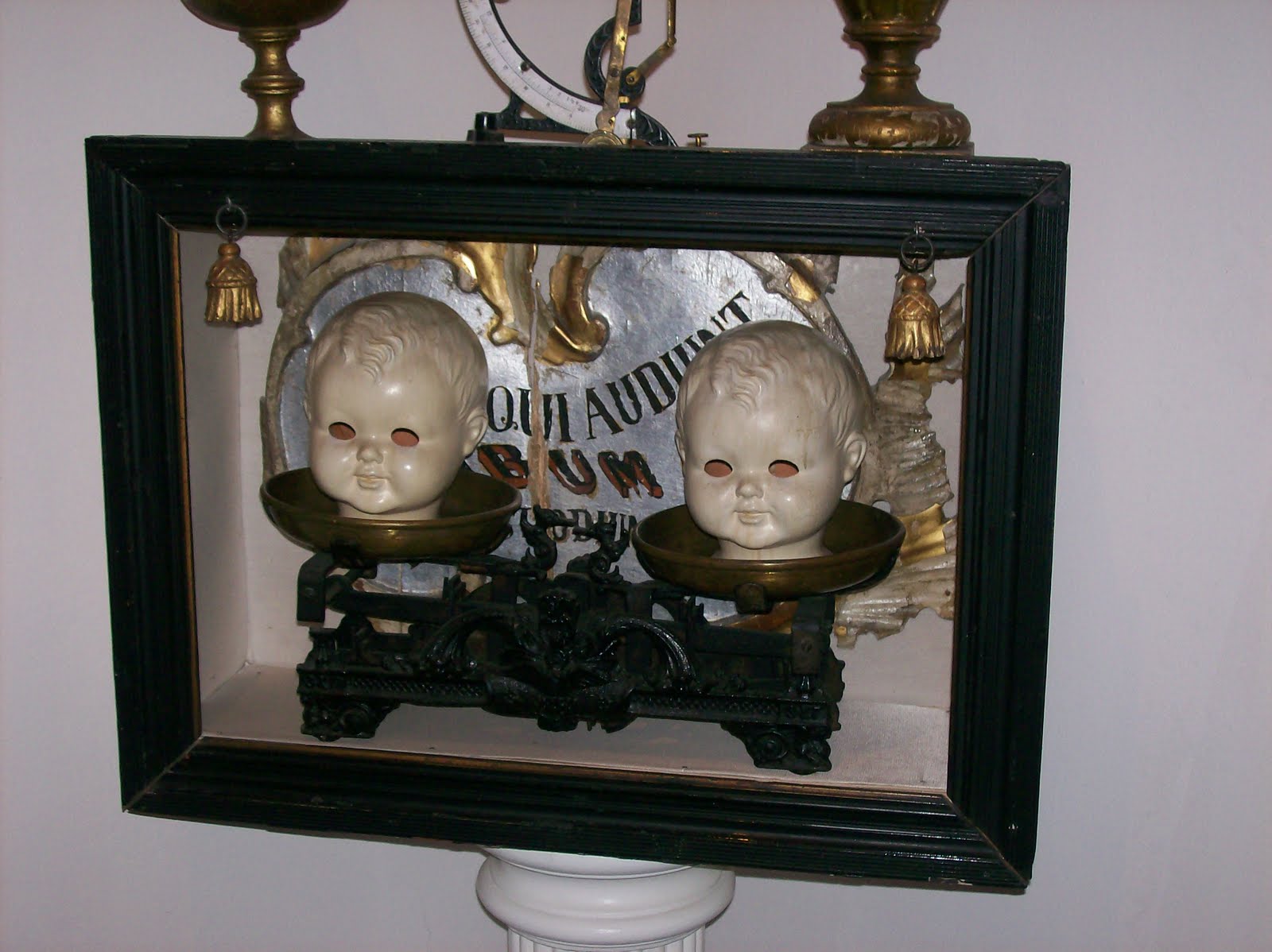
Nor did i before living in Armenia. Parajanov's house museum is a little-known gem of Yerevan -- a bit of lore passed between travelers. As is the case with many house museums in Armenia, Parajanov never actually lived there. Though ethnically Armenian, he was born in Georgia and lived much of his life in Ukraine. The house was built in the late 80s in order to entice him to move back to Armenia, but he died before it was finished. Now it's filled with props from his movies and his collage and bricolage art. Distrusted by the soviet regime, Parajanov was imprisoned and sent to labor camps three times for subversiveness in his art and personal life. Some of the sketches he made in prison are displayed in the final room of the house tour. Despite their darkness, they show Parajanov's unbridled intensity.


Tbilisi at Night


Monday, August 2, 2010

The National Museum

In our wanderings, we also happened on the National Museum, which is only partially closed for renovations. The treasury room, only available if you pay for a guide, was definitely worth the admission. It houses an impressive collection of primarily religious artifacts, though the bronze age jewelry is also notable. The real draw of the museum, though, is in the dank, poorly lit "Asian collection". If you can hold your nose past the musty rooms of Persian paintings and inlaid furniture, if you venture past the guard and her 10-year old daughter painting their nails, in the far back corner you'll find...
an Egyptian mummy!
Just chilling there in a mildewy basement room in Tbilisi. Don't know about you, but i'm going to get cremated.

Sunday, August 1, 2010

The Man in the Leopard's Skin

The main drag leading into the old town, with the opera house (closed for renovation), the cinema (closed for renovation), the history museum (closed for renovation), the parliament building (closed to the public) and Georgia's first McDonald's (....open), is Shot'ha Rust'haveli St. Rustaveli Street is also home to Prospero's Books and Calaban's Cafe. Located in a well-marked but secluded courtyard, they emulate a western European atmosphere so well it approaches denial. Fellow travelers who have said we could get by in Georgia with only English mush have been thinking of this place, because everywhere else we've had to speak Georussarmenglish with a heavy embellishment of signs.


When there's a major street, as well as a bus and metro stop, named after someone, it has to peak one's interest -- even more so when the person is not a dictator or military leader. "Who was this Rust'haveli?" I casually wondered. As i was browsing in Prospero's Books, i came across numerous copies of a book called, alternately, "The Knight in the Tiger's Skin," or "The Man in the Panther's Skin," by Shot'ha Rust'haveli. I've never heard of a panther in this area, but there is a Caucasian leopard. So i'm calling it a leopard's skin, and the illustrations in the book support my theory.


The Man in the Leopard's Skin is a late 12th/early 13th century Georgian epic poem that recounts Persian palace romance about two pairs of lovers divided. The writing reminds me of Indian classical romances, in which new stories blossom from the conversations of characters, and new stories from the characters in those stories, etc. While there were never multiple nested stories in The Man..., the narrative flows very freely between characters. And like Homer's poetry, many of the lines are completed with epithets that have little bearing on the present action. In fact, every time two characters meet, they exchange at least 4 lines a piece describing the other's beauty and prowess. Every time they part, at least 8 lines are devoted to the tears they shed at the separation. As interesting as these passages are from a cultural perspective, by the second half of the poem it's difficult not to skim when the hero's face is once again referred to as "the crystal and the coral" or when, on his departure, his companions again refer to themselves as roses who will wither without the sun's presence.


In conjuring his fictional Arabia, Persia and India, Rust'haveli filled in the gaps in his knowledge with fantasy and Christian and Hellenistic culture. The characters are devout muslims, but the fact that the author is not makes for some interesting slips. Not that the inaccuracies are distracting -- if anything, they contribute to the story's magic. The poem is considered one of the most important literary works in the Georgian canon. What it implies about the Georgian character for their great masterpiece to be a Persian story, I will leave for someone more knowledgeable to answer.

The complete text in English can be found at this website.

Escapades

Since we had no idea what to do at first, we wandered around for the first couple days. We still managed to see some of the major sites on accident:


My bad Russian ordered me 20 khinkali (dumplings).


The opera house (closed for renovations)


Trinity Cathedral

Saturday, July 31, 2010

HOTb'lisi, GA


Vee begeen our journee een Tfleez, ze capitol ov Gruzia. According to the clock, Tbilisi is an inexplicable 1 hour behind Armenia's capital, Yerevan, which is actually further west. However, on arriving in Tbilisi, the visitor quickly realizes that Georgia is in fact 49 years, 364 days and 23 hours ahead of Armenia.

Despite the disgusting waters of central Mtkvari River (see above photo) and the constant struggle with traffic, the city has a totally unexpected Byzantine charm. Many of the churches are well-restored and active, and the traditional iconography, bas reliefs and enamel art are still being done. Much like in Armenia, even these sacred sites were littered with bottles, but there are two big differences: 1, in Georgia it's beer, not vodka, bottles, and 2, no one was trying to drag a sheep into the chapel. Which really explains the allure of both places.

IN our usual fashion, Sierra and i got into town with pretty much zero knowledge about the place, carrying literally 200 lbs. of luggage. Fortunately, many of the taxi drivers in town are Armenian, so aside from having to heft two gigantic suitcases onto a small, beat-up jalopy, we were able to get to the metro without much trouble. We made it to the metro stop of our friend's friend, Natalie, who was nice enough to put us up for the night and store our bags. We were a few hours early, so we got to sample some of the Tbilisi boondocks. We had planned to while away our time at a cafe until Natalie could meet us, but after several attempts at asking, "где кафе?" and passing and endless row of pharmacies and slot casinos, we rested our sweaty backs in the yard of an apartment building. However, there were 3 things we learned to appreciate very quickly-- 1, Tblisi has a lot of trees. Precious shade giving trees. 2, Delicious, fatty khachapuri (cheese-filled flatbread) can be bought on the street for 1 lari (about 60 cents). 3, Delectable Georgian sodas and draught beer can be purchased on street corners. That is what i call good urban planning.